
Nearly every couple who reaches out to me says the exact same thing: “We’re awkward in front of the camera.” It doesn’t matter how beautiful, confident, successful, outgoing, or photogenic they are in daily life — almost everyone believes this about themselves. Out of hundreds of couples, I can count on one hand the people who were naturally at ease in front of a camera (and the one that stands out were both professional actors). In other words, awkwardness isn’t rare. It’s universal.
Because couples feel this way, they often assume the solution is to avoid posing altogether. They ask for photos that feel “natural,” “candid,” or “just us being ourselves,” because they’re worried posing will make them look stiff or uncomfortable. The impulse makes sense, but the conclusion is backwards.
Awkwardness doesn’t come from you. Rather, it comes from the absence of direction.
Structure gives your body something to do. It tells your hands where to rest, your gaze where to land, your energy where to focus. Once those pieces are in place, the tension dissolves and your natural expressions rise to the surface. This is why guidance is essential for people who identify as “awkward.” It replaces uncertainty with orientation, which is the first step toward genuine ease.
Direction is what solves that problem, not what causes it. Though I’m a photojournalistic-style wedding photographer (and you can find out more about what the means in my guide below), there is so much more involved.
Table of Contents
Why awkwardness increases without structure
Imagine standing in front of a photographer who says, “Okay, just act natural.” What does that even mean? Natural for who? In what context? How do you instantly shift from self-conscious to candid? No couple can magically produce natural ease on command, especially if the reason they’re avoiding posing is because posing already feels intimidating.
When couples tell me they feel awkward, I know exactly what they need: direction that gives their bodies something to do, their attention somewhere to go, and their connection with each other a real chance to surface. Without that, most people default to stillness, freezing, overthinking their expressions, or worrying about how they look. That internal tension immediately shows up in the images.
This is why leaving awkward couples completely undirected doesn’t create candid portraits. It creates uncertainty. When there’s no structure, you’re stuck guessing what to do — and guessing is the fastest path to discomfort. Direction is all about support.

Why comfortable, camera-confident people need less direction (and why that’s not most couples)
A small number of people truly don’t need guidance: actors, performers, models, content creators, or anyone who regularly practices being on camera. They fall into flattering angles instinctively and interact freely without tightening up when the lens appears.
But they’re the exception.
Most couples getting married, especially at San Francisco City Hall (which attracts a lot of ‘low key’ people who deliberately avoid the pomp & circumstance of a big, traditional wedding), are regular people who haven’t spent years studying their angles or practicing movement. They’re normal humans who get nervous, who overthink their smiles, who don’t know what to do with their hands. Expecting them to be instantly candid without support is unrealistic and unfair to them.
Direction fills that gap between how they feel and how they want to appear in their photos.
What good direction actually does
Good direction is clear and confident. I tell you exactly what to do because guessing is what makes people tense. When someone shows you where to stand, how to shift your weight, where to place your attention, or how to move with your partner, the uncertainty drops away and you settle into the moment.
To the contrary, strong, direct guidance doesn’t make you or your photos look stiff. It makes you relax because you’re no longer trying to figure everything out on your own.
Silence does the opposite. When a photographer stops talking, most couples start wondering whether something is wrong or whether they’re supposed to be doing something differently. The mind spirals. Clear cues steady you, and that steadiness builds trust quickly. Trust is what allows people to feel confident in front of the camera.
Direction also creates a sense of partnership. You’re not performing alone; someone is actively shaping the moment with you. That reassurance shows up immediately in posture, breathing, and facial expression.
Where candid-feeling portraits actually come from
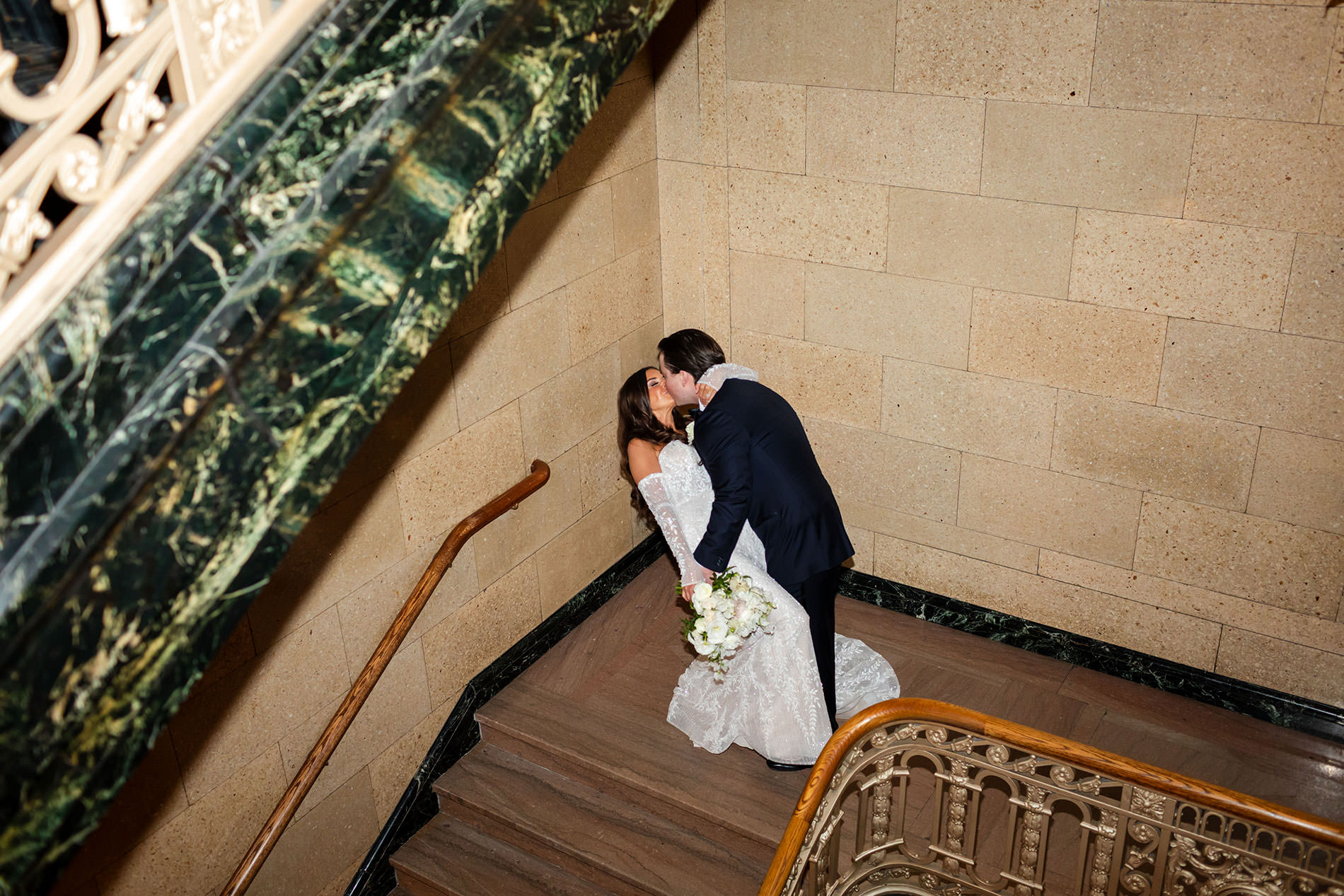
Candid-feeling portraits come from structured direction paired with your real reactions. My team and I guide you decisively into positions that work well on camera, and the candidness emerges in the moments that follow. The breath you release, the glance at your partner, the laugh that bubbles up once you’ve settled in. These transitions are full of life, and they photograph beautifully.
Decisive posing matters because it creates the framework that allows spontaneity to appear.
Direction creates presence. ➵ Presence creates comfort. ➵ Comfort creates photographs that feel candid.
Most couples assume posing makes them look stiff, when the opposite is true. Lack of posing is what keeps people tense. Clear, confident guidance allows you to loosen up and be natural.
In the section below, I’ll touch on the principles behind candid-feeling portraits, so you can keep these ideas in mind as you prepare for your wedding day. But there’s one other piece that matters just as much and is often overlooked.
As wedding photographers, we never stop shooting.
The photographs that feel most natural are very often made just before or just after a “pose.” The moment when you laugh at something I’ve said. The breath you let out when I say “that’s perfect.” The split second of relief when you think we’re finished and your shoulders drop. Those moments are not accidents. They’re part of the process, and they’re where a lot of the real magic lives.
This is very different from formal portraiture, where everything stops for a single, fixed smile. Wedding photography doesn’t work that way. Every transition, every adjustment, every reaction is fair game. Sometimes the pose itself is simply a way to get you comfortable, connected, and present. The image that ends up being your favorite might happen as you’re settling into it, or as you’re stepping out of it.
Because we’re photographing continuously, nothing is wasted. The posed moment, the in-between moment, and the moment after all have equal potential to become the photograph.
That’s why direction and candidness are not opposites. Direction creates the conditions where those unguarded reactions can surface, and because we’re there for all of it (shooting thousands of frames, sometimes well into 5 figures!) we don’t miss them.

The principles behind candid-feeling portraits
The reason candid-feeling portraits work is not luck or chemistry alone. There are a few consistent principles I return to again and again when I’m directing couples, because they reliably produce images that feel relaxed, connected, and unforced.
You don’t need to memorize these or perform them. This is simply a window into how I’m thinking while I’m guiding you. This guide below also give a lot more insight on where ‘candid feeling’ photos really come from (hint: it’s not from the photographer).
Connection comes first
Most of the direction I give is about creating physical and emotional connection between you and your partner. Small points of contact matter. Where your bodies meet, where your hands rest, how close you allow yourselves to be.
Connection doesn’t need to be exaggerated to read as meaningful on camera. A hand placed at the waist, fingertips brushing an arm, foreheads or temples close together. These moments communicate intimacy without requiring you to “act romantic, if that doesn’t feel like you”
I’ll often guide you into a position that brings your bodies closer, then let the moment breathe. The candid expression usually arrives right after, once you’ve settled into that closeness.
Loose limbs photograph better than rigid poses
Stiffness is what reads as awkward on camera, not posing itself. I’m always watching for tension in arms, shoulders, hands, and legs, and adjusting accordingly.
A slight bend in the arms, weight shifted onto one leg, hands resting lightly instead of hanging. These are small refinements, but they change the way a body reads in a photograph. They also make you feel more comfortable physically, which shows immediately in your face.
I’ll often give very specific instructions here, because clarity is what allows you to relax. When your body feels at ease, your expression follows.
A strong starting position matters
I use a reliable starting pose as a foundation, especially when we’re moving quickly between locations or working within time constraints. From there, we make small variations rather than reinventing the wheel each time.
This gives us consistency without repetition. It also means you’re never standing there wondering what to do with your body. Once you’re placed, everything else becomes easier — looking at your partner, laughing, moving in closer, or briefly acknowledging the camera.
The structure does the heavy lifting. Your reactions fill in the rest.
Movement creates natural reactions
Stillness tends to make people self-conscious. Gentle movement does the opposite.
I’ll often ask you to walk together, shift your weight, sway slightly, or move your hands along your partner’s back or arm. These aren’t random actions. They give your body something to do, which quiets the part of your brain that’s worried about being photographed.
Movement also creates variation without forcing anything. One prompt can produce several distinct moments, each slightly different, each more natural than the last.
Prompts are meant to be interpreted, not performed
Much of my direction is intentionally open-ended. I’ll suggest an action or a starting point, then let you take it in your own direction.
Every couple has their own physical language. The way you touch, tease, comfort, or joke with each other is specific to you. I’m watching for that and making space for it to show up, rather than overriding it with something generic.
If something I suggest feels off or unrecognizable, we move on immediately. There’s no attachment to any single pose. The goal is always images that feel like you, not a checklist of shots.
I have a separate guide all about the principles behind wedding posing linked below. This is also shared with all couples about 3 weeks before their wedding.
The difference between “posed,” “candid,” and “candid-feeling”
Documentary candid moments happen when you’re not thinking about the camera at all — during getting ready, with your family, during emotional exchanges, on the dance floor. Those unfold organically throughout the day.
Candid-feeling portraits, however, are created through a blend of direction and authenticity. You’re aware of the camera, but your reactions are real because you’re supported enough to relax into the moment. Your expressions are genuine. Your connection is genuine. The resulting image feels like you.
Many couples prefer candid-feeling portraits without realizing that thoughtful direction is what made them possible.

Why direction is the anchor awkward people need
When I give instruction, I’m not placing you into stiff shapes. I’m giving you something to respond to so you’re not left inventing intimacy or interaction from scratch. You interact the way you already do, but with more awareness of light, composition, and flow.
Awkwardness often shows up as tension — raised shoulders, frozen hands, tight posture. Direction helps dissolve that tension by clarifying what you’re doing. When people know where to look or how to lean into each other, they stop focusing on the camera and start focusing on their partner.
This is why some of the best candid-feeling images happen immediately after a prompt. The pose melts away, the real moment appears, and the photograph feels honest.
Why timeline and emotional readiness matter for awkward couples
Direction only works when you have the mental space to receive it. If the wedding day is chaotic — constant movement, dozens of decisions, tight timelines, or interruptions — the body goes into survival mode. People brace instead of soften.
Couples who identify as awkward genuinely benefit from:
- A bit more time during portraits
- A calmer environment
- A moment to breathe
- Fewer distractions
- A photographer whose communication is steady and clear
Awkwardness thrives when you feel watched or overwhelmed. Comfort thrives when you feel supported.
Your photographer’s job is to create that support — but you have to allow space for the process to unfold.

Posing is not the opposite of candid, it’s the pathway to it
One of the biggest myths couples believe is that posing and candidness sit on opposite ends of a spectrum. They don’t. Posing creates the conditions that lead to candid-feeling images.
When you’re guided into a position that feels comfortable and grounded, your mind relaxes. Your energy shifts. You stop performing and you start connecting. And when your connection surfaces, the candid expressions follow.
Direction frees you. It frees you from guessing, overthinking, and from the pressure to “be candid” on command.
You don’t have to stop being awkward. You just have to let yourself be guided
Awkwardness is human. It’s not something you have to hide or apologize for. Most people are awkward when a camera appears — that’s precisely why photographers like me exist. My job is to take that tension and turn it into comfort; comfort is what becomes photos that feel like you at your best.
Your only job is to show up willing to be guided, to interact with your partner, and to trust the process.
If you feel awkward, you don’t need fewer poses. You need better support. And that’s exactly what direction provides.

Zoe Larkin
I’m Zoe, a wedding photographer based in San Francisco! My style is candid, capturing authentic moments for my couples all over the Bay Area and Northern California. Creating content is my passion! Follow along on the blog, Instagram, TikTok & YouTube!


Be the first to comment