
Couples often ask whether they should send photo inspiration (Instagram posts, Pinterest pins, mood boards etc) to their wedding photographer ahead of the day. Sometimes the question comes framed as etiquette: is it rude? Sometimes it’s practical: is it expected? Other times it’s driven by anxiety, a desire to feel prepared, or a fear of disappointment.
It’s a reasonable question. Weddings are expensive, emotional, and often the first time people have ever hired a professional photographer for something this personal. Wanting clarity, reassurance, and some sense of control is completely understandable.
Many couples wonder whether they should send Pinterest boards or inspiration photos to their wedding photographer — especially when they’re trying to be helpful or prepared.
My answer, based on years of photographing weddings, tends to surprise people. In most cases, sending photo inspiration is not necessary, and in some cases it can actually make the experience and the final images – and crucually, the experience – worse rather than better.
To explain why, it helps to look at a completely different scenario.
So, I’m trying a new hairstylist tomorrow morning, and before I walk into the appointment, I have to do some work for her. (I actually should be doing it right now, but instead I’m writing this blog post).
To prepare for my appointment, I need to think carefully about what I want, what absolutely won’t work for me, and what has and hasn’t worked over the years. I need to bring inspiration images, not because I expect to walk out looking exactly like those photos, but because the stylist can only work with the information I give her. She doesn’t live in my body, she doesn’t know my history with my hair, and she doesn’t have to deal with the result for months afterward.
If I walk in and say to my hair stylist, “Do whatever you think is best,” I’m gambling. Sometimes people get lucky. Most of the time, they don’t.
What’s interesting is that wedding photography works almost the opposite way, and this mismatch is at the root of many disappointments I see with wedding photos (thankfully not my clients, but you hear horror stories from around the industry).

Table of Contents
Why wedding photography is different: photo inspiration etiquette for wedding photographers
With a haircut, the responsibility sits heavily with the client. The stylist can only respond to the constraints and preferences that are clearly articulated. The less specific the client is, the more the stylist defaults to something safe, generic, or familiar to them.
Wedding photography behaves differently. Here, too much specificity from the client actually can be a negative.
That feels counterintuitive, especially in an internet culture that tells couples to prepare extensively, curate inspiration boards, and pre-plan every detail. The advice usually comes from a good place. People want reassurance. They want to feel prepared. They want to avoid regret.
The problem is that photography doesn’t thrive under those conditions.
What couples are actually hiring a wedding photographer for
When you hire a wedding photographer, you’re not hiring someone to reproduce a set of images that already exist. You’re hiring someone because you trust how they see, how they respond in real time, and how they interpret what unfolds in front of them.
A wedding day is not a controlled environment. It’s emotional, unpredictable, and constantly changing. Light shifts unexpectedly. Timelines slip. Weather intervenes. People behave differently than they imagined they would. Moments happen quickly, often in between the “important” parts of the day. We’re there to respond to the unique chemistry between two people, and the wider interactions that happen completely unprompted.
The strongest photographs usually come from awareness and responsiveness, not from adherence to a pre-written plan.
This is why two photographers can stand in the same place, at the same time, and produce completely different bodies of work. The value is in the interpretation.

The limits of inspiration photos
Inspiration photos aren’t inherently bad or unwelcome. It just means they’re often misunderstood, and therefore over-weighted.
When couples look at a photograph they love, they’re usually responding to a combination of things. It might be the expressions, the couple’s connection, the softness of the light, the color palette, or the overall mood. Sometimes it’s all of those things at once, or something else entirely.
What’s rarely obvious is how specific and contextual those images are. They were created in a particular location, at a particular time of day, in a particular season, with a particular couple, under particular circumstances. Even when a similar pose is attempted, the surrounding conditions are never the same.
Many of the images that circulate most widely online come from styled shoots. These are intentionally constructed environments with models, controlled lighting, generous timelines, and a singular focus on aesthetics. Real weddings do not operate that way.
Why shot lists usually backfire
One common instinct is the shot list. Just like being prepared for your haircut by carefully curating a Pinterest board, you might be tempted to put together a shot list, whether in visual or written format, as a helpful guide for your photographer.
On paper, it feels helpful, practical, and responsible.
In practice, it does the exact opposite of what couples intend.
Experienced wedding photographers already know how to document the standard moments of a wedding day. Ceremony, portraits, family groupings, details, key interactions — this knowledge is foundational.
Shot lists for anything other than family/friend groupings also puts unnecessary pressure on the photographer, because now on top of trying to make beautiful art out of the source material that is unfolding in front of us, while also having to stick to a rigid timeline, moving it along with authority while also appearing carefree and easy-going, while also have a huge smile plastered on your face while fielding questions about our cameras from Uncle Bob, we now also have to check inspo images on our phones.
Where shot lists cause problems is in how they narrow attention. When a photographer is mentally tracking a list, they are less free to notice the subtle, unscripted moments unfolding around them. The glance between two people. The fleeting expression. The interaction that happens just outside the expected frame.
These moments cannot be planned, and they’re often the ones couples treasure most later. When too much emphasis is placed on checking boxes, those moments are easier to miss.

Why light matters more than any shot list
One crucial factor that shot lists completely overlook is light.
Light is the foundation of photography. It dictates where we place you, which direction you face, when something works, and when it doesn’t. This is not something most couples could reasonably anticipate, because light changes constantly and behaves differently in every space. It also isn’t universal. Each photographer reads and uses light in their own way, based on experience, instinct, and style.
While we’re interacting with you, giving direction, and keeping things relaxed, we’re also tracking where the light is falling, how it’s changing minute by minute, and how to position you relative to it. We’re adjusting our own position in relation to you and the environment. All of that is happening quietly and continuously, even though it looks effortless from the outside.
Shot lists work against this process. They assume that moments can be executed independently of conditions, when in reality the quality of a photograph is deeply tied to where the light is at that exact moment. Following a pre-written list can force a photographer into situations with flat, harsh, or unworkable light, simply to satisfy an expectation that doesn’t serve the final images.
Trusting your photographer to follow the light allows them to make decisions that you wouldn’t know to make, and shouldn’t have to. That flexibility is what produces photographs that feel intentional, dimensional, and alive, rather than technically correct but visually dull.
The communication gap most couples don’t realize exists
Another challenge is that visual communication is harder than it looks.
When a couple sends an image and says they love it, that image can mean very different things to different people. A client might be responding to the emotional tone, while the photographer is noticing the light. A client might love the color palette, while the photographer is reading the composition. Without context, inspiration images can create misalignment rather than clarity.
This is one of the reasons couples sometimes feel disappointed even when they’ve shared extensive inspiration. The information they thought they were conveying wasn’t actually the information the photographer received.

What about only sharing images taken by that photographer?
Every photograph is specific to a particular couple and a particular moment in time. Even images from your own photographer’s previous work are reflections of a unique relationship, a specific dynamic, the exact conditions of that day, even things like the height differential between a couple or some other variable that allowed the posing to work, which it may not in every case. The people, the energy between them, the lighting, the pace, the emotional tone: none of that is transferable in a literal sense.
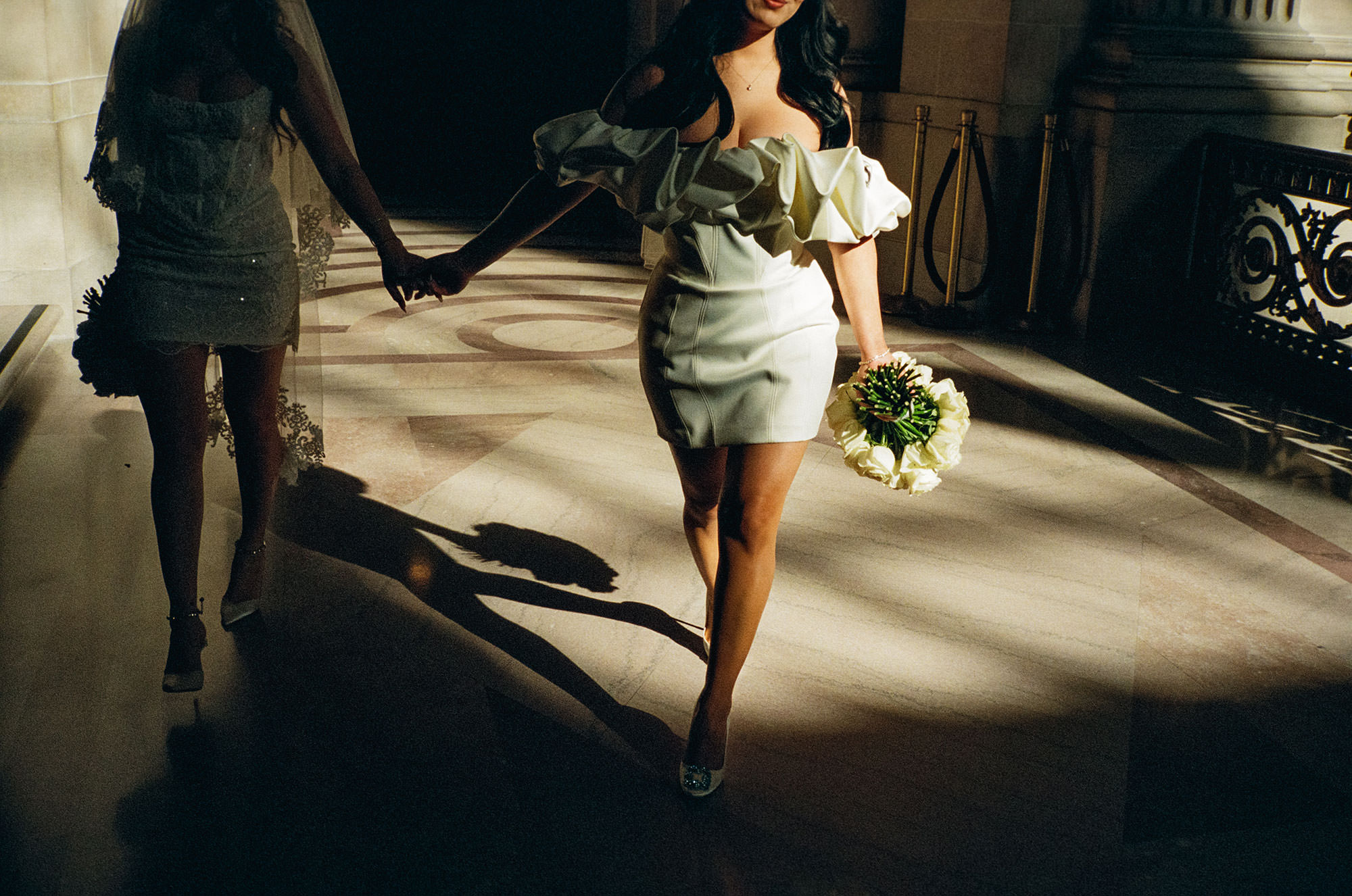
Couples sometimes assume that referencing a photographer’s past images means those images can be recreated. In reality, those photographs exist because of a precise convergence of circumstances that cannot be repeated, even with the same photographer and yes, the same building (San Francisco City Hall, I’m looking at you 👀).
And it’s not just limited to City Hall. So, so many of the locations I shoot at regularly for both weddings and engagement sessions are public. They aren’t private venues where we have our run of the place. We will always have to work around other people using the space, closures, other events, construction – things that commonly limit how we can use a given area.
Where inspiration can be useful is as a loose indication of what you’re drawn to, rather than as a visual target. Looking at a photographer’s existing work can help you understand how they tend to see moments, handle light, and tell stories. It can also help you articulate preferences around mood or energy, provided those preferences are framed as values rather than instructions.
When inspiration shifts from reference to expectation, it risks flattening the individuality of your day and placing unnecessary pressure on both you and your photographer to chase something that belonged to someone else.

What works better than a shot list
Instead of directing specific photographs, it’s far more effective to communicate priorities, however, even this is not necessary.
This might include letting your photographer know:
- Which relationships matter most to you
- Which moments you’re particularly excited about
- Which locations feel meaningful
- A particular vibe you’d like to lean into more (e.g. moody, playful, editorial, silly and unserious, ‘cover of Vogue’, etc)
- If you have any insecurities about your appearance, a ‘good side’, etc.
- How you like to show affection to each other (e.g. do you not like to kiss? Are you playful and goofy? Do you like old romance or more fresh and modern? Do you like steamy poses or more traditional and conservative? If you don’t know, that’s fine too! This is just an example of something you might feel strongly about.
Sharing emotional context gives your photographer something far more valuable than a list of poses. From there, the work becomes interpretive rather than transactional.
If you must include inspiration photos, remember
If it makes you feel more prepared to share images, then go for it, ultimately we can’t stop you. But here are some important guidelines and caveats:
- ✅ Stick to sharing images from your photographer’s own catalog of work.
- ✅ Stick to either a maximum of 3 photos, or if it’s more of a slide deck/ Pinterest board, then understand it’s more the vibe than any individual photos that will be recreated.
- ✅ Explain exactly what it is that you’re looking at – do you like that pose? The facial expressions? The backdrop? The colors? The editing?
- ✅ Remember that lighting is the most important part of photography. As those in front of my lenses are not professional photographers, you will not understand what kind of light I’m looking for, as it has taken me over a decade to begin to understand light. Therefore, leave it to us to decide where the best and most flattering photography opportunities will come from at that moment we’re taking them.
- ✅ Send photos from the same venue or time of year, e.g. photos where rose bushes feature prominently are going to look very different in November.
- ✅ If you’re eloping (just the couple), or have a super unrushed day, then it can be easier to make time to look carefully over the inspiration photos than a big, bustling celebration where we need to constantly be on the lookout for moments. However, this isn’t always the case, and sometimes smaller celebrations ironically end up having way more packed into them due to smaller budgets (not wanting to spend as much on more hours of photography can equate to a whirlwind schedule quickly shifting from one activity to the next).
- ✅ We won’t be looking at Pinterest boards the day of, but we’ll try to familiarize ourselves with your vision beforehand and then leave some room for creativity and your special chemistry on the day.
- ✅ Rather than a list (which feels prescriptive), let them know on the day, in the moment, the vibe or style you most like.
- ✅ Trust your photographer to create something that uniquely fits you as a couple and the day you had, and tells your intimate wedding story with sensitivity and warmth. If you can avoid sharing any shot lists/ inspiration photos to recreate, please do. The only exception might be if you’re working with someone who has extremely limited experience photographing couples/ weddings.

Trust as the differentiator
If you want strict replication, detailed direction, and full control over every frame, there are photographers who specialize in that approach. Usually newer photographers that lack experience. It’s a valid choice, as long as expectations are aligned.
If you want images that reflect the day you actually experienced, trust becomes the most important ingredient.
As a photographer who’s photographed over 600 weddings, believe me, I’m used to slotting into every kind of family, relationship dynamic and culture under the sun.
We are used to sensitive situations, to people who express their love differently than most, to posing under many different circumstances. Beyond a list of formal family groupings, which only the couple can define, most of what matters happens in the moment.
Unlike services that follow a fixed outcome, wedding photography is highly responsive. The strongest work comes from observing light, movement, and interaction as they unfold, and making decisions in real time.
When that space exists, the photographs tend to feel cohesive and alive. Less like a checklist, and more like a true record of the day as it was experienced.

Zoe Larkin
I’m Zoe, a wedding photographer based in San Francisco! My style is candid, capturing authentic moments for my couples all over the Bay Area and Northern California. Creating content is my passion! Follow along on the blog, Instagram, TikTok & YouTube!


Be the first to comment