
Why should you consider a first look? There’s something powerful about seeing the person you’re about to marry for the first time on your wedding day. Whether that moment happens at the altar or during a first look, it’s emotional every single time.
A first look is a private, pre-ceremony moment where you see each other before walking down the aisle. And yes, I’m a big fan of a first look. Not because it’s trendy (it’s actually more ‘the norm’, now), and not because it’s required; but because a first look consistently creates a calmer, more intentional start to the day.
Some couples hesitate about doing a first look on their wedding day because it feels “non-traditional.” But once they understand what a first look actually gives them — more time, less stress, and more connection — it becomes a very easy decision.
If you’re unsure about doing a first look, here’s what you should know.
Planning a first look at San Francisco City Hall? City Hall has its own logistical quirks, so I’ve written a separate guide that goes deeper into locations and how to time it properly – linked below:
Table of Contents
What is a first look?
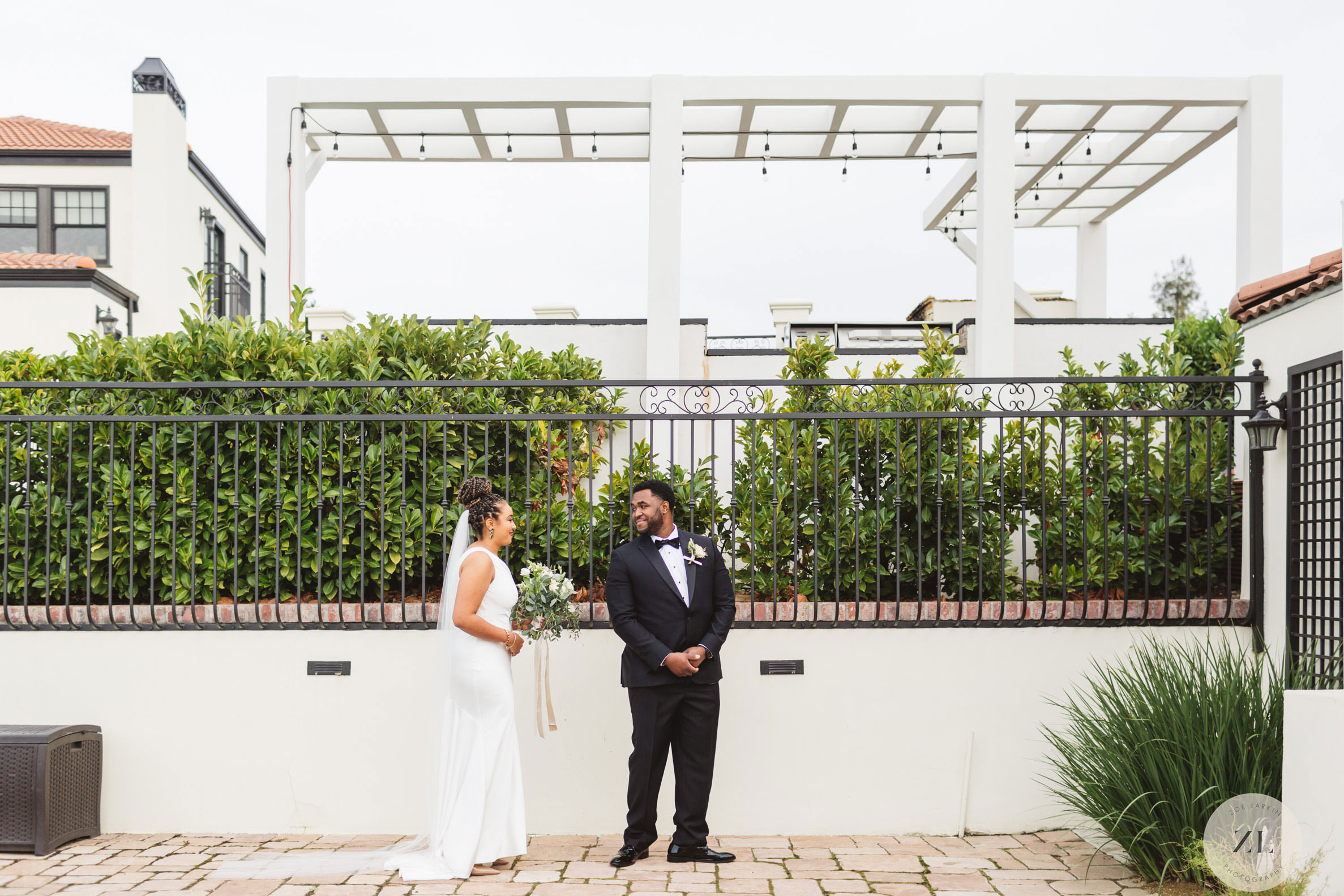
A first look is a private moment before your ceremony where you see each other for the first time on your wedding day. It usually happens somewhere quiet, away from guests, with just the two of you and your photographer.
Instead of waiting for the aisle reveal, you choose to stay separate until that moment, and share your genuine, private (and sometimes very emotional) reaction to seeing other for the first time.

The pros of doing a first look
You get more portrait time (and better photos because of it)
When you choose to do a first look, we don’t just “see each other and move on.” We immediately roll into a dedicated portrait session while you’re fresh, calm, and fully present.
Those portraits? They’re the ones you’ll frame. The ones that end up on your walls. The ones your parents ask for copies of.
If you wait until after the ceremony to do all of your couple portraits, you’re working against a compressed timeline. Cocktail hour is short. Guests are waiting. Light may be fading. And there’s often subtle pressure to move quickly.
With a first look, we build in intentional portrait time earlier in the day. We can explore multiple locations. We can adjust for light. We can slow down instead of sprinting through a checklist.
There’s also a practical side to this: as the day unfolds, things can shift. Hair and makeup can run late. Family photos can take longer than expected. Transportation can hit traffic. If your only portrait window is after the ceremony, you’re vulnerable to losing it.
A first look gives us portraits “in the bank.” If something unexpected happens later, you already have a full, beautiful set of images of just the two of you.
And in my experience, wedding days with first looks consistently produce more portraits overall — not because I shoot more, but because we simply have more time and flexibility to work with.
You get ‘photo insurance’
Think of a first look as an insurance policy for your wedding photos.
Wedding days are tightly scheduled and emotionally full. Even when everything is well planned, there are variables you can’t control — weather shifts, delays, venue restrictions, family dynamics, timeline compression, or simply the reality that sunset happens in the middle of a busy reception.
Your main portrait session is usually at sunset. That’s the light we’re aiming for. That’s the moment that gives you those soft, cinematic images. But stepping away during dinner or dancing doesn’t always unfold as smoothly as it does on paper.
When you’ve already done a first look, you’ve secured a meaningful private reaction and a strong set of portraits earlier in the day. You’re no longer depending entirely on one later window to deliver all of your couple images.
We’ve created space in the timeline. We’ve built flexibility into the structure of the day. And if sunset ends up shorter than expected — or doesn’t happen at all — you’re still walking away with beautiful, intentional photographs of just the two of you.
That’s why I describe a first look as photo insurance. It protects the images that matter most.
You actually get to spend more of the day together
A first look changes the rhythm of the day in a quiet but important way.
Without a first look, you spend the entire morning and early afternoon intentionally avoiding each other. You’re in separate rooms. You’re managing nerves independently. You’re building up to one big moment at the ceremony.
When you choose to do a first look, you get to share that anticipation together.
You get a few private minutes before the schedule pulls you in different directions. You get to talk. Laugh. Breathe. Adjust each other’s outfits. Let the reality of the day settle in.
After that, you’re no longer counting down to the aisle moment. You’re moving through the day as a team.
Couples often tell me this is what surprised them most. The day feels longer. More connected. Less compartmentalized.
Instead of spending half your wedding day apart, you actually get to experience it together.

It may be the only time you’re truly alone together all day
Wedding days are public. Even the quiet moments usually have someone nearby — a planner, a photographer, a parent, a bridal party member.
A first look creates a pocket of privacy before the ceremony begins. It’s often the only part of the day where you can stand together without an audience and let the reality of what’s happening settle in.
You can talk. You can react honestly. You can cry if you want to. Or laugh. Or just breathe.
That shift matters.
When couples go straight from separate preparation into a ceremony full of guests, the emotional release happens in front of everyone. When you’ve already shared that first moment privately, you enter the ceremony feeling grounded instead of overwhelmed.
It also changes your portraits. You’re not trying to manufacture connection while family waits nearby. You’ve already connected. The photographs reflect that.
For many couples, that first look becomes the most personal part of the day.
You’re photographed at your absolute best
Your hair and makeup have just been completed. Your bouquet is fresh. Your dress is perfectly pressed. Everything looks exactly as it was designed to look.
A first look allows us to photograph you during that window, before hugs, weather, movement, and the natural progression of the day start to shift things.
Those early portraits capture the details at their sharpest — clean makeup, structured florals, smooth fabric, boutonnières that haven’t wilted. The overall look is polished and intact.
If you plan to do a first look, it’s wise to have your hair and makeup artist stay until after those portraits are finished. That way, you walk into the ceremony looking just as refined as you did moments before.
It’s a simple scheduling choice that preserves the work you’ve invested in.

It gives you more privacy for emotional reactions
Not everyone is comfortable being emotionally exposed in front of a crowd.
For some couples, the idea of crying, laughing, or reacting openly in front of 150 people feels natural. For others, that level of attention creates pressure. Even people who consider themselves confident can feel unexpectedly self-conscious when they know every eye in the room is watching.
A first look creates space for a more private reaction.
Without an audience, you don’t have to perform. You don’t have to manage your expression. You don’t have to wonder how you look. You can respond instinctively and honestly. That often leads to a reaction that feels more relaxed and more personal.
Couples who choose a first look frequently describe feeling more grounded afterward. The emotional intensity of seeing each other has already happened in a quiet setting. When the ceremony begins, they’re able to focus more fully on their vows and the meaning of the moment rather than the anticipation of the reveal.
It doesn’t make the ceremony less significant. It simply allows the most vulnerable reaction to unfold in a setting that feels contained and comfortable.
For couples who value privacy or who dislike being the center of attention, this can be one of the most compelling reasons to do a first look.
You get two reactions instead of one
One of the biggest concerns I hear is that a first look will take away from the ceremony moment.
In practice, it usually creates two very different experiences instead of replacing one.
The first look is private. You have space to react naturally, to talk, to laugh, or to just stand there and take each other in without an audience. The pressure drops. The day starts to feel real.
Then the ceremony still carries its own emotional weight. The music, the anticipation, the presence of your family and friends — it changes the energy entirely. The walk down the aisle doesn’t feel redundant. It feels heightened in a different way.
The reaction at a first look is about intimacy. The reaction during the ceremony is about significance. They don’t compete with each other. They land differently.
Couples are often surprised by how distinct those moments feel.
It can improve your focus during the ceremony
That said, one unexpected benefit of a first look is how it can change the way you experience the ceremony itself.
When you haven’t seen each other all day, the emotional intensity of that first moment can be overwhelming. For some couples, that rush of adrenaline carries straight into the vows. It’s powerful, but it can also be distracting.
When you’ve already shared a private first look, the initial shock has softened. The nerves have settled. You’ve had a moment to connect and recalibrate.
That often allows couples to step into the ceremony feeling more steady and present. Instead of processing the reveal and the vows at the same time, you’re able to focus more fully on what’s being said and what you’re promising to each other.
I’ve noticed that couples who do a first look tend to feel more grounded at the altar. The ceremony becomes less about managing emotion and more about participating in it.
The significance isn’t reduced. The attention is clearer.

You will be able to get family formals done before the ceremony
One of the most practical benefits of a first look is that it allows us to complete your family formals before the ceremony even begins.
After your first look and couple portraits, we can gather immediate family and take care of those important group photos while everyone is fresh and present. By the time your ceremony ends, the formal photo list is already behind you.
That changes the entire flow of your reception.
Instead of disappearing during cocktail hour to line up relatives and work through a shot list, you’re actually there. Cocktail hour is when the best candid moments happen — guests reconnecting, hugs, laughter, drinks in hand, everyone relaxed. And all of those people are there to celebrate you.
Before the ceremony, the atmosphere is naturally calmer. Guests haven’t arrived. The schedule has breathing room. It’s much easier to step away for thirty minutes and move efficiently through family portraits without feeling rushed or watched.
Handling formals earlier keeps the post-ceremony momentum intact and lets you move straight into enjoying your reception.
You have more time to actually enjoy your guests and can attend cocktail hour
When family formals are completed before the ceremony, the shift after you walk back down the aisle is immediate. You’re not disappearing for forty-five minutes. You’re not lining people up. You’re not managing a checklist. You’re fully present.
Cocktail hour becomes what it’s meant to be — a transition into celebration rather than an extension of logistics. You can move freely, greet people naturally, hug your college roommate without watching the clock, and actually absorb the atmosphere of the day.
Wedding days move quickly. You’ll be pulled in different directions all night. A first look gives you back a pocket of time that would otherwise be consumed by structure.
It’s one of the few choices that directly increases how much of your own wedding you get to experience.
It helps calm nerves
Wedding days are emotionally intense. Even the calmest couples feel it. You’re about to walk into a room where everyone is looking at you, waiting for one very specific moment.
For some people, that anticipation builds excitement. For others, it builds pressure.
A first look softens that edge. Instead of holding everything in until the ceremony, you get a private moment to connect beforehand. You can say a few words to each other. You can laugh. You can steady each other. You can remember that you’re marrying your best friend, not performing for an audience.
I’ve had many couples — especially partners who were initially skeptical of a first look — tell me afterward that it completely changed how they felt walking into the ceremony. The nerves were still there, but they weren’t overwhelming. They felt grounded and ready rather than anxious and exposed.
Seeing each other beforehand doesn’t remove the significance of the ceremony. It often allows you to step into it with more confidence and clarity.

Your timeline becomes less stressful
When you choose to see each other before the ceremony, we can complete couple portraits, wedding party photos, and often family formals earlier in the day. That redistributes the schedule instead of stacking everything into the narrow window between ceremony and reception.
Without a first look, the post-ceremony timeline tends to feel compressed. Guests are waiting. Light is shifting. You’re moving quickly from one grouping to the next. Even when it’s organized, it can feel hurried.
With a first look, the day breathes differently. The ceremony becomes a transition into celebration rather than the starting gun for a long photo checklist. You move into cocktail hour and the reception with far less logistical pressure.
From a planning perspective, it simply creates more flexibility. And flexibility is what keeps wedding days feeling calm instead of chaotic.
You get the advantage of daylight
A first look changes the structure of your day in a way that most couples don’t fully appreciate until they see it on paper.
If you’re getting married between November and March, daylight becomes a planning factor.
In winter, the sun sets around 5pm. Many ceremonies begin in the late afternoon, which means natural light can be limited afterward. A first look allows us to schedule your couple portraits earlier in the day while the light is still soft and flattering.
That timing gives us more options. We can use outdoor spaces comfortably, take advantage of natural light, and create portraits that feel open and dimensional rather than relying entirely on evening lighting conditions.
When natural light is important to you, building the schedule around it leads to stronger, more consistent results.
At this point, it’s probably clear where I stand.
I do think a first look is a strong choice for most couples. Not because it’s trendy, and not because it replaces tradition, but because after photographing hundreds of weddings, I’ve consistently seen how much calmer, more flexible, and more connected the day feels when couples choose to see each other beforehand.
I don’t make apologies for recommending it.
That said, a first look isn’t automatically right for everyone. There are real trade-offs. And if you feel strongly about waiting until the ceremony, it’s worth understanding what that choice changes.
Here’s what to consider if you decide not to do a first look.

Disadvantages of having a first look
It is more traditional to wait until the ceremony
For some couples, tradition carries real weight.
Seeing each other for the first time at the altar is a powerful image — the music begins, the doors open, and the entire room witnesses that initial reaction. There is a purity to that moment that feels deeply ceremonial.
If that experience is central to how you’ve always imagined your wedding day, then waiting until the aisle may feel right to you.
From a practical standpoint, choosing not to do a first look does shift how photography works. If you want to fully capture both reactions — the partner walking down the aisle and the partner waiting at the front — a second photographer becomes far more important. In large or visually complex spaces, one person cannot always be in two places at once.
It also changes the energy of the earlier part of the day. When couples are intentionally kept apart, part of my role becomes managing separation — coordinating movement, redirecting pathways, preserving the reveal. That effort is completely worthwhile if the aisle moment is your priority, but it does require structure.
Waiting until the ceremony keeps the tradition intact. It simply reshapes the timeline and the photography coverage around that choice.
It may require an earlier start time
A first look shifts a meaningful portion of your photography earlier in the day.
In order to complete couple portraits, wedding party photos, and often family formals before the ceremony, the schedule has to begin sooner. That can mean starting hair and makeup earlier than you would if all portraits were happening after the ceremony.
For some couples, that’s a small adjustment. For others, especially with large wedding parties or complex logistics, it requires careful planning.
Because the first look is emotional, it’s also wise to plan for touch-ups. Tears are common. Lipstick rarely survives. If you want to walk into the ceremony looking as polished as you did during portraits, consider having your hair and makeup artist stay through the first look, or make sure you have a clear touch-up plan in place.
Clear communication becomes essential. Your photographer, planner, family members, and hair and makeup team all need to understand the timeline. Preparation time has to be realistic. Buffers matter.
An earlier start isn’t a negative in itself, but it is a commitment. It can sometimes carry extra cost too, like more hours of photography and videography overall. If you value a slower morning or want extra rest before the ceremony, that’s something to weigh when deciding whether a first look fits your day.

Guests may see you before the ceremony
If you’re planning a first look close to guest arrival time, there is a chance that a guest or two may catch a glimpse of you.
With smaller weddings in particular, guests often arrive early. There are always a few who show up ahead of schedule. If we’re photographing in a visible area, it’s possible that someone could see you before the ceremony officially begins.
For some couples, that matters. They prefer to remain completely out of sight until the aisle moment. Others are less concerned and see it as a minor detail rather than a disruption.
From a logistical standpoint, this is usually manageable. We can choose more private locations or adjust timing to reduce the likelihood of overlap. Most guests understand what’s happening and are respectful if they notice you mid-portrait.
Still, if the idea of being seen before the ceremony genuinely bothers you, that’s something to factor into the decision.
Lighting may be less ideal earlier in the day when a first look happens
On many wedding days, the first look and pre-ceremony portraits happen in the late morning or early afternoon. That’s often when the sun is highest and most direct.
Midday light can be harsher. It creates stronger shadows, brighter highlights, and sometimes more contrast than the softer light closer to sunset. Certain venues offer plenty of shaded or diffused areas, while others are more exposed and limit options.
An experienced photographer can work thoughtfully within those conditions — positioning you with the sun behind you, finding open shade, using architecture strategically — but the quality of light at that time of day is simply different from golden hour.
For couples who place a high priority on that soft, low-angle sunset light, it’s worth understanding how the timing of a first look interacts with the environment.
It changes the emotional build-up of the ceremony
For some couples, part of the meaning of the wedding day is the slow build toward the aisle moment.
You spend the morning apart. You sit with the anticipation. You feel the nerves rise. The ceremony becomes the first time you see each other, and that reveal carries all of that accumulated emotion.
A first look redistributes that arc. The intensity doesn’t disappear, but it unfolds earlier and more privately. The ceremony still holds significance, but the emotional pacing feels different.
Neither approach is more valid. They simply create different experiences.
If the idea of saving that first sight for the aisle feels essential to you, that instinct matters.

It changes the emotional pacing of the morning
For some couples, part of the wedding day magic is the slow build.
Getting ready separately. Feeling the anticipation rise. Knowing that the ceremony will hold the first moment you see each other.
A first look shifts that rhythm. The emotional high point moves earlier in the day. The anticipation resolves privately rather than building all the way to the aisle.
Some people love that redistribution. Others prefer the suspense to carry straight into the ceremony.
It’s less about logistics and more about atmosphere. If you’ve always imagined that long, steady crescendo leading to the aisle, that instinct is meaningful.
It requires more early-day coordination
On a similar note, but speaking more about logistics: a first look concentrates more activity into the earlier part of the day.
Couple portraits, wedding party photos, and often family formals all need to be organized before the ceremony. That means people have to be dressed on time, ready on time, and in the right place on time.
Location matters, too. Some venues won’t allow access until a certain hour, or they restrict where you can photograph before guests arrive. In those cases, we may need to use an alternate spot nearby — a courtyard, a side street, a lobby, even the sidewalk outside. I’m comfortable working creatively with whatever we have, and many couples end up loving the candid, “real city” feel of those images. But it is a different look than photographing entirely inside a venue.
Family members also need clear instructions, and transportation timing has to be accurate. If hair and makeup runs behind, the schedule tightens quickly.
None of this is unmanageable, but a first look works best when the morning is structured and everyone understands the plan.
Weather conditions may be less forgiving earlier in the day
When a first look happens earlier in the afternoon, you’re working with whatever the conditions are at that time.
In warmer months, temperatures can be higher and the sun more intense. In wind-prone locations, breezier mid-afternoon conditions can affect hair, veils, and lightweight fabrics. Certain outdoor venues offer plenty of coverage, while others leave little shelter from heat or direct light.
Later in the day, conditions often soften — temperatures drop, wind calms, light becomes more diffused. That shift can change the overall feel of outdoor portraits.
This doesn’t make a first look impractical. It simply means that timing interacts with environment. If you’re planning an outdoor wedding in a climate with extreme heat, strong wind, or minimal shade, that’s worth factoring into the schedule.
How to decide what’s right for you
After photographing hundreds of weddings, I’ve seen both approaches work well.
A first look creates measurable advantages: more usable portrait time, more flexibility in the schedule, and often a steadier emotional start to the day. Waiting until the ceremony preserves a very specific kind of anticipation — the slow build that culminates in that aisle moment.
The right choice comes down to what matters more to you. Do you want the ceremony to hold the entire reveal? Or do you want to redistribute that emotion earlier in exchange for a more flexible timeline?
It’s also a practical decision. The season, the sunset time, your venue’s access rules, and the size of your guest list all influence how the day will realistically unfold.
If you’re leaning toward a first look, I recommend it confidently for most couples. I’ve seen how it shapes the rhythm of the day, and I’ve seen the difference it makes in both experience and photography.
At the end of the day, it is a personal decision. Every vendor, including myself, will have their opinion, but don’t let your vision for your wedding be railroaded in the process. Whatever you decide, choose it deliberately.

Zoe Larkin
I’m Zoe, a wedding photographer based in San Francisco with over 600 weddings under my belt, documenting love stories all over the Bay Area and Northern California. My work combines directed portraiture with candid coverage of the people and moments around you. Follow along on the blog, Instagram, TikTok & YouTube!


Be the first to comment