
I recently received an email from someone considering working with me, asking whether I had experience with an “editorial” style of wedding photography, beyond “candid, natural coverage”.
It was a completely reasonable question, but I realized I did not have a particularly useful one-line answer – hence this blog post.
Wedding photography is full of words like editorial, documentary, candid, natural, traditional and fine art. Photographers use them. Clients use them. I use some of them myself. The problem is that they do not have fixed meanings, and two people can use exactly the same word while picturing very different photographs.
Her question also brought up something I have been trying to reconcile in my own work for a long time: I talk quite a lot about photojournalism, yet the way I photograph weddings at San Francisco City Hall is extremely directive.
So this seemed like a good time to explain what I actually do, and what you can expect from both the day-of process and the final images when you choose me (or someone from my team) as your San Francisco City Hall wedding photographer.

Table of Contents
I am not a photojournalist at San Francisco City Hall
Many people who have followed my work for a while will know that photojournalism has always been an important part of how I think about wedding photography. I have even written an entire article about my photojournalistic approach to wedding photography. So much so, in fact, that the footer of this website describes us as photojournalist wedding photographers.
That still accurately describes a huge part of how I photograph full wedding days outside City Hall.
Which makes what I am about to say sound slightly contradictory: at San Francisco City Hall, I am absolutely not working as a photojournalist.
Across a full wedding day, there are long stretches where my job is primarily to observe: getting ready, guests arriving, cocktail hour, dinner, speeches, kids running around, grandmas crying, dads taking photos, emotional reactions, dancing, and all the small interactions that nobody planned. If something meaningful is already happening, I want to photograph it without interfering.
City Hall weddings work very differently. They are compressed, fast-moving and take place in a public building shared with dozens or hundreds of other couples, guests, tourists, photographers, staff, quinceañeras, protests and events. There is much less room for me to simply stand back and see what happens, and that’s never been my approach there.
I am planning, organizing, directing, composing, troubleshooting and keeping things moving. I choose portrait locations based on the light, architecture, crowds and whatever is happening in the building that day. I decide where people should stand. I direct bodies, hands, faces and movement. I adjust clothing and bouquets. I organize family photographs. I change direction when a location is too busy or something is no longer working.

For romantic portraits especially, I give a lot of direction. I don’t take a couple somewhere beautiful and wait to see what they do spontaneously.
Instead, I construct many of those photographs very deliberately.
What I carry over from photojournalism is not the overall way I work at City Hall, but the habit of paying attention. I never stop watching for the things I did not create: a reaction during the ceremony, someone fixing a piece of clothing, a parent wiping away a tear, a laugh between photographs, your guests running up to hug you.
If something real is already happening, I do not need to manufacture another version of it. I photograph it.
That also means I am not exclusively focused on the couple. I spend a lot of time watching and photographing the people around you too: both the formal photos you have asked for and the natural reactions, personalities and interactions that happen around them. I want the gallery to show who was there and what they were like.
So the contradiction is actually less dramatic than it first appears. At City Hall, my overall approach is highly directed, but my documentary instincts are still running underneath it the entire time.

Wedding photography rarely belongs to one style
This is also why I struggle with describing any wedding photographer as belonging entirely to one photographic style.
Different parts of a wedding require different responses.
A family group photograph needs organization. A portrait may need careful posing and composition. A ceremony usually needs restraint. A genuine interaction may be ruined by intervention. A difficult location may need much more control from the photographer.
Knowing which approach to use is part of the job.
Sometimes I construct the photograph. Sometimes I give a small amount of direction. Sometimes I see something happening and do absolutely nothing except photograph it.
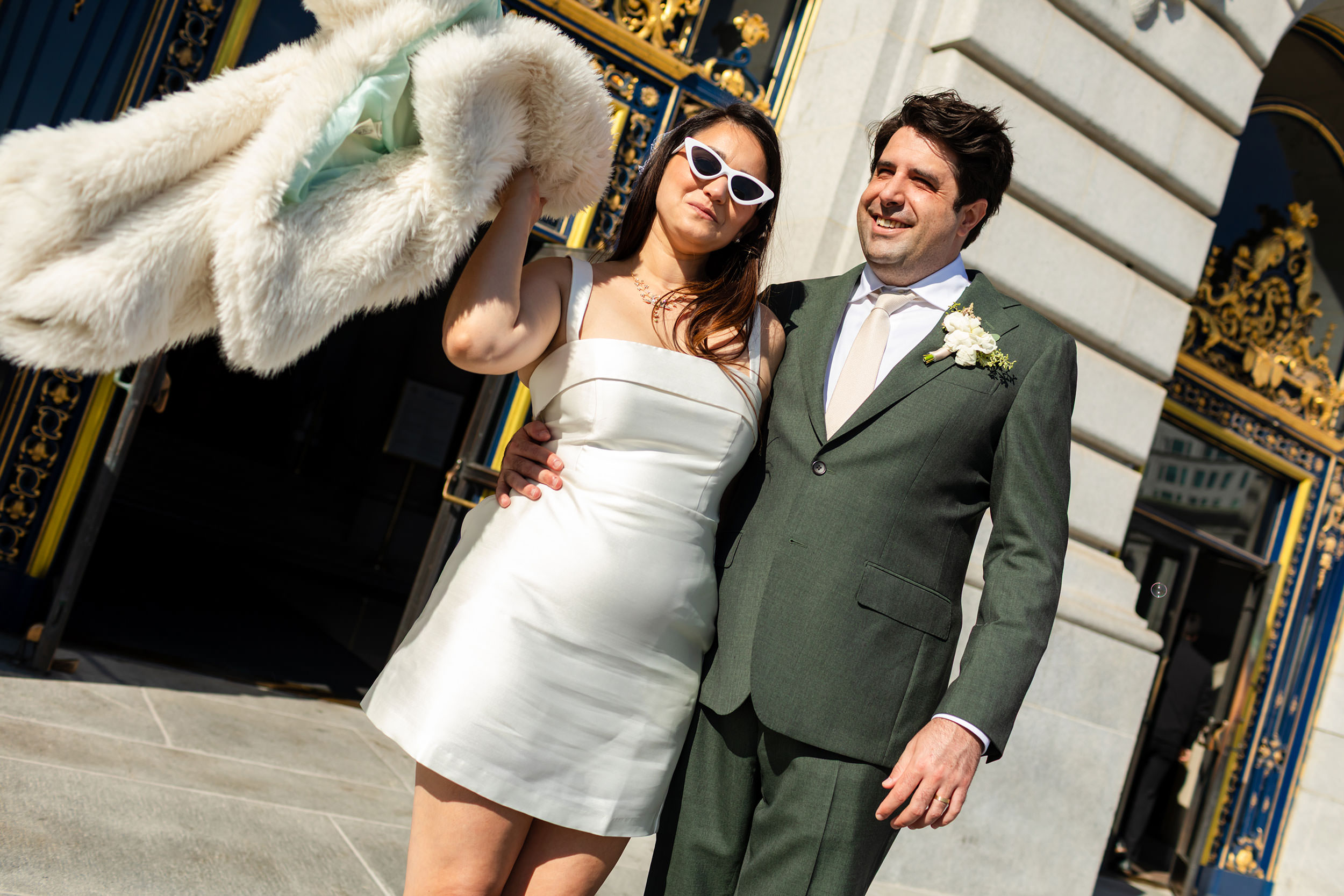
The finished gallery can therefore contain photographs that someone might describe as traditional, documentary, candid, editorial, architectural or fashion-influenced, all from the same wedding. The images you’ll see in this post are all from one City Hall wedding with 2 hours of coverage.

So what does “editorial” mean?
This was the hardest part of the original question for me to answer.
“Editorial” has become one of the most common style descriptions in wedding photography, and I am still not convinced everybody means the same thing by it.
Part of the confusion is that these words are not necessarily describing the same thing. “Photojournalistic” says more about how a photograph is made: observing what is happening rather than constructing it. “Editorial” often says more about how a photograph looks. A highly directed photograph could look traditional, romantic, architectural or editorial, while a photograph can also have an editorial quality without being heavily staged.
Sometimes people mean very deliberate compositions and posing. Sometimes they mean wide-angle photographs, tilted frames, direct flash, flash outdoors, greater depth of field or other techniques associated with contemporary fashion photography.
Sometimes the qualities have surprisingly little to do with camera technique.
In a lot of the contemporary wedding photography described as editorial, the couple has neutral or serious expressions rather than smiling. The images may feel cooler, more detached or effortless. The clothing may be particularly fashion-forward. Hair, makeup, florals and the overall styling of the wedding can contribute enormously to whether a photograph reads as “editorial.”
A photographer cannot create every part of that.
I can choose a lens, composition, aperture or lighting technique. I can direct somebody’s body and expression. I can decide where and how to photograph them, but I can’t turn the people, clothing and styling in front of me into something they aren’t.
The couple, their clothing, their personalities, the architecture, styling and everything else in front of the camera remain part of the photograph.
So if by editorial you mean photographs that are intentionally composed, polished, fashion-conscious or shaped around the architecture, then yes, that is very much part of how I photograph at City Hall.
If by editorial you mean a photographer whose entire approach is built around staged, fashion-led image-making, that would not be how I describe my work.
And somebody else may use the word differently again.

What you can actually expect from me at City Hall
If I had to describe it plainly, I would say my San Francisco City Hall work is highly directed, portrait-led photography with a documentary eye.
The portraits are intentional. I am thinking about composition, architecture, light, body position, expression and how the photograph will actually look. Around that, I am constantly watching for the ceremony, reactions, guests, interruptions, laughter and all the things that happen without my involvement.
If you are looking for someone to stand back and simply document whatever happens at City Hall, I am probably not the right photographer. Equally, if you want the entire experience built around highly staged, fashion-led image-making, that is not really what I do either.
My approach sits between those extremes. I take control where the photography benefits from control, and I leave things alone when the real moment is better than anything I could manufacture.
And ultimately, I do not think the best way to understand any photographer’s style is through the words they use to describe themselves. Look at full galleries.
A homepage, Instagram grid or portfolio shows a photographer’s selected highlights. A full gallery shows how they actually photograph an entire wedding: portraits, ceremony, family photos, guests, transitions, difficult light, quiet moments and everything in between. That is the only way to know whether the way they consistently see and photograph a wedding feels right to you.
That is why I send full galleries from a similar type of San Francisco City Hall wedding to every couple who inquires with us. If you want to see more, or want examples with a particular feel, ceremony type or photographic approach, just ask. I would much rather you look closely at the actual work than try to decide whether one adjective describes it.
If you book one of my associate photographers rather than me, the same overall approach applies: clear direction where it is needed, documentary awareness throughout, and the same ZLP editing process. Each photographer naturally has their own eye, so I always recommend looking through their portfolio and full galleries too.
If any of this resonates with you, I’d love to hear from you!


Zoe Larkin
I’m Zoe, a wedding photographer based in San Francisco with over 600 weddings under my belt, documenting love stories all over the Bay Area and Northern California. My work combines directed portraiture with candid coverage of the people and moments around you. Follow along on the blog, Instagram, TikTok & YouTube!


Be the first to comment