
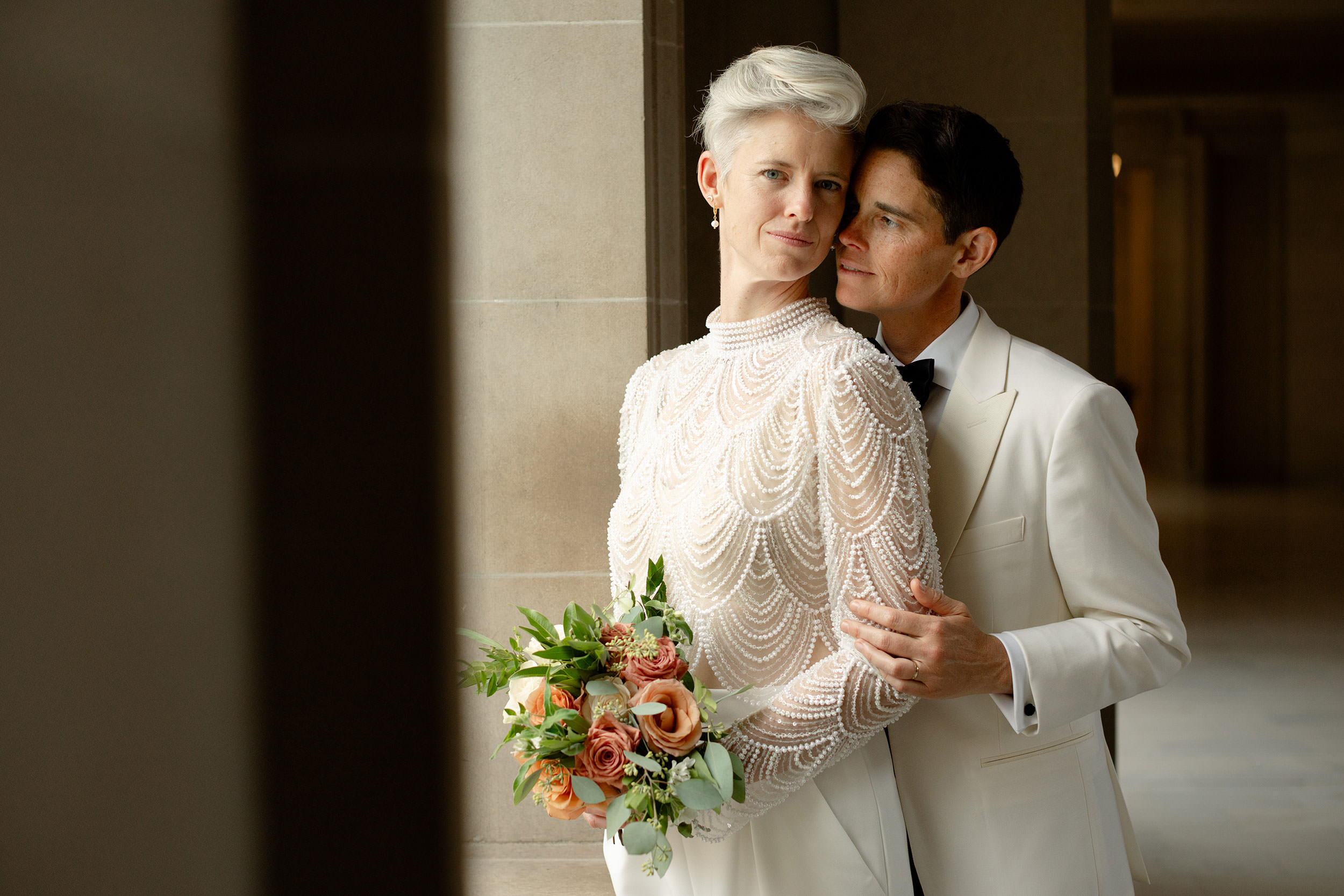
Though I’m not a floral designer, couples often ask me whether I recommend having flowers for their San Francisco City Hall wedding. My general recommendation is yes, if you like florals and the cost and logistics make sense for you. Floral design contributes a lot visually at City Hall, and a bouquet is useful during portraits in ways that go beyond simply looking pretty. A bouquet also:
- Gives you something to do with your hands
- Provides a way to add personalization – especially important with a courthouse wedding
- Adds color, texture and an organic element to City Hall’s formal architecture.
- Adds a sense of occasion that immediately reads as ‘wedding’
While the vast majority of our couples opt for florals for their SF City Hall wedding, some do not, and others go for a twist on the traditional. The decision usually comes down to a few factors:
- What florals add to the photographs
- What you want your final look to say
- What you are comfortable spending
- How much coordination you want to add to your wedding experience

Table of Contents
How much does a City Hall wedding bouquet cost in San Francisco?
Cost is probably the biggest practical factor in deciding whether to have florals, so it’s worth putting actual numbers on it.
As of October 2026, I would budget roughly $250 — $450 for a professionally designed fresh wedding bouquet in San Francisco. Small or super simple bouquets can start around $150, while larger bouquets, premium flowers and more customized designs can cost $500 or more. Specific flower requests can also affect the price, since availability changes throughout the year. You can also expect prices to increase over time, as the cost of doing business rises.
When you work with Zoe Larkin Photography, we’ll provide a customized vendor recommendation list of a bunch (no pun intended) of floral designers who specialize in SF City Hall weddings, and / or have small minimums (important to know, as many popular Bay Area floral designers only offer full-service wedding florals, usually with restrictive minimums). Many of my recs are based in other Bay Area cities, in case you’d prefer to pick them up locally.
A la carte is the way to go with a City Hall wedding, which typically only calls for two pieces – some combination of a bouquet and a boutonniere, for most couples.
Whether spending $250, $350 or $450 on floral design feels worthwhile is entirely personal. If that amount would take money away from something you care about more, that is a perfectly reasonable reason to skip the bouquet or choose a less expensive floral option. That same amount could buy you:
- A half-hour more photography coverage that could create a much less stressful experience
- An extra night at a local hotel
- Getting extra alterations on your dress to ensure a perfect fit, or correct undergarments to avoid costly Photoshop work afterward
- Upgrading your makeup/ hair style
- Drinks for your guests at your reception
- Luxury transportation to and from the wedding
On the other hand, if you’re weighing the cost against photographic impact (not necessarily all the things you could spend money on, in terms of the overall experience), floral design is one of the few purchases that will appear prominently throughout your wedding gallery. Aside from the ceremony – when you’d hand your bouquet to someone else so you can join hands with your partner – it will appear in most if not all of your wedding photos.

Why florals make such a difference in City Hall photos
San Francisco City Hall gives us a lot to work with, but unlike a traditional wedding venue, you generally aren’t personalizing the space itself with decor. A bouquet, along with your attire, is one of the few personal design elements you can bring into that environment. I cover other ways to personalize a City Hall ceremony in this separate guide.
If you’re having a private City Hall ceremony, there is another category of floral design altogether: ceremony installations, which the above guide goes into in great detail. Those come with their own rules around size, setup and removal, so I’ve covered them separately there so you can make your San Francisco City Hall wedding extra special.
Flowers also introduce something visually different from the building itself – which is symmetrical, formal and architectural – and adds color, texture, softness and an organic shape.
What size bouquet should I get?
I tend to think about the bouquet’s scale and shape in relation to the person carrying it and the clothes they’re wearing. This is where an experienced floral designer can be helpful as they can offer a perspective that takes into account the person carrying it, not the design in isolation.
A very large bouquet can swamp someone who is shorter or slighter, while a very small bouquet can get lost against a taller or broader frame, particularly with a more dramatic or voluminous outfit. Longer, cascading bouquets can work especially well with taller, leaner proportions, while on a shorter person, dramatic length can be used deliberately to create a more elongated vertical line. None of these are rules, and deliberately playing with proportion can of course be part of the styling.
The bouquet’s physical heft is worth considering as well. Dense stems can add a lot of weight, with garden roses, hydrangeas, peonies and king proteas in particular being very heavy. You’ll be carrying the bouquet for the duration of photography, which can be 2+ continuous hours. I’ve had many brides become exhausted carrying an unwieldy, heavy bouquet during this time, especially amid a very overheated, sometimes less-than-comfortable environment.

A bouquet gives you something to do with your hands in photos
There is also a very practical photographic reason I recommend having a bouquet: it gives your hands something to do!
During romantics and group formals, a bouquet creates an easy default position. You can hold it, carry it to one side, hold it centered between you, walk with it, or put it down at times.
This gives me another element to work with, but I do not want to overstate the importance of it. You can absolutely be photographed well without holding anything. I pose brides without bouquets all the time. In fact, not having a bouquet leaves both hands free to interact with your partner such as by holding each other, caressing, and moving more freely, rather than having your hands clamped around the bouquet’s stem for each shot.
Holding a bouquet gives us another option, particularly during the parts of the session where you are standing more formally and wondering what on earth people normally do with their hands. While I’ll guide wherever possible, it isn’t always feasible to pose each person’s every limb and digit in every photo. Holding onto a bouquet with one or both hands leaves one less thing to second-guess when it comes to posing.
How floral design interacts with your wedding attire
If you are wearing a gown, veil, tuxedo or another traditional wedding look, a bouquet can add another layer of texture and shape to the overall styling. It also becomes a prominent object sitting directly against attire you may have spent a great deal of time choosing.
This is one reason I pay attention to bouquet construction and finishing. A highly polished outfit tends to make an unfinished bouquet more noticeable.
With non-traditional choices like a jumpsuit, colored dress, separates, suit, mini dress, adding flowers can give the overall look more wedding context or even add to the deliberate subversion of the ‘wedding look’ norms. That can work particularly well for someone who wants to retain their personal style while still having the images clearly read as wedding photographs.

Why I recommend professional floral design
I always recommend using a professional wedding floral designer if the budget permits.
The biggest difference is visual judgment. A professional has a trained eye for proportion, balance, color, texture, movement, negative space and how an arrangement reads as a whole. Most of us can tell whether we like a bouquet, but that is different from understanding why one arrangement looks beautifully resolved and another looks slightly off. A floral designer is making dozens of small decisions that most clients would never know to make.
They are also designing the bouquet as something that will be carried against a person, not simply admired as a flower arrangement. They consider its scale and shape in relation to your body and clothing, where the visual weight sits, how the flowers move, and how the bouquet looks as you hold it in front of you, carry it at your side or tilt it while walking. The handle, stems, ribbon and underlying mechanics are part of that same three-dimensional design because all of them can become visible, and the construction needs to hold up throughout the day.
Professional floral designers also have access to higher-quality flowers and understand how different varieties, colors and textures work together, and in what proportions. An inspiration image may look effortless, but translating it into an actual bouquet takes considerably more than finding similar florals and putting them together. The finished result depends on choices about scale, spacing, structure, movement and the materials themselves. Their expertise is visible in the finished piece.
DIYing your City Hall bouquet
A DIY bouquet and boutonniere can be an option, especially if you have craft experience or a specific design in mind.
If possible, make a trial bouquet in advance. Hold it while wearing your wedding attire and look at the scale against your body. Photograph it from the front, sides and underneath.
Tape, rubber bands, exposed wire, plastic wrapping, makeshift ribbon and uneven or unfinished stems can become much more obvious in high-resolution and close-up photographs than they seemed while you were assembling the bouquet.
The timing is also awkward. You need to make your bouquet close enough to the wedding that it still looks good, but realistically you won’t be assembling it on the wedding day. It then needs to survive storage, whatever temperature and conditions happen, transportation to City Hall, being carried throughout the photography portion, and potentially traveling to another location afterward, all without the flowers drooping or the bouquet coming apart.
If you genuinely do not care whether the finished bouquet looks professionally designed, that may be an easy tradeoff. But most people investing in professional wedding photography care quite a lot about how the visible details come together. If you know you would be disappointed later by something that looks noticeably homemade or unfinished, factor that into your decision before you choose DIY.
Below are some self-made bouquets that turned out beautifully. In my experience, the strongest DIY results usually come from either the person getting married or someone close to them who already has strong craft skills, or from practicing the bouquet in advance.

What about an artificial bouquet?
Artificial flowers can make a lot of sense for City Hall weddings, particularly when convenience is a major consideration. If you’re sensitive to pollen, faux flowers can work especially well.
You can order them well in advance, pack them in your suitcase, have them waiting in your hotel room, travel with them, and avoid worrying about keeping fresh florals fresh. They can also become a keepsake afterward if that appeals to you.
There are also rental companies such as Something Borrowed Blooms (not sponsored!), which several of my couples have used. They send professionally arranged faux wedding flowers before the wedding, which you mail back afterward.

Sola wood flowers are another option that has become fairly popular. You can buy them as finished arrangements or assemble your own, and they are available in a much wider range of colors than you would typically encounter in fresh florals. However, in my experience, sola wood bouquets tend to have a dense, rounded or heavily structured shape. Cascading and more asymmetrical styles do exist, but I rarely see the loose, airy garden-style shapes that are common with fresh floral design. Personally, I’m not a fan of the compact sola silhouette in photographs, as it can read stiff and dated to me.
You can buy an artificial bouquet outright, whether it is silk, fabric or another material. Lead times vary depending on the customization required, and quality also varies enormously, which is where I would pay the most attention.
The photographic tradeoff with all of these options is that artificial flowers may look – well, artificial – particularly in close-up photographs. Some have very uniform petals, visibly synthetic stems or textures that catch the light differently from fresh flowers. Whether that bothers you is a personal call, and for many couples the convenience outweighs that difference. Below are examples of how some more faux florals photograph:

The logistics of fresh florals on your wedding day
Fresh flowers require a little more coordination than people sometimes expect. Don’t assume an à la carte bouquet is a same-day purchase, either. Order deadlines vary, so check this when you’re comparing floral designers.
Someone has to pick them up or receive a delivery. They need to stay fresh, in water, until you are ready to leave, then be transported in one piece.
For a local couple with an afternoon ceremony, this may be barely worth mentioning. For someone staying in a hotel and beginning hair & makeup at 3.30am, and photography at 8am, bouquet pickup can become surprisingly awkward.
If you pick up fresh florals the day before, think about where they will spend the night. A floral designer can keep flowers in appropriate conditions before collection; your hotel room, Airbnb or home may be considerably warmer. During hot weather spells, arrangements that looked perfect at pickup may look quite different after sitting overnight without cool storage.
Investigate the timing and availability of pickup or delivery before you order so you’re not left scrambling the day before the wedding. Ask when the florist opens, whether delivery is available and how much extra it costs, how early they deliver and whether the bouquet can safely be collected the previous afternoon.
I had a client who ordered wedding florals from Costco, but unfortunately had them delivered too early. By wedding day, they were wilted and brown, and the couple had to buy a replacement bouquet and boutonniere locally at much greater cost.
One City Hall-specific rule to know: handheld personal flowers are fine, but don’t toss or scatter loose petals inside or outside the building, including on the front steps. In practice, the concern is anything that leaves debris behind, whether the petals are fresh, dried or faux. City Hall staff and sheriff’s deputies monitor the building closely, and will ask patrons to clean up any petals or paper left behind, so I would avoid planning a petal toss altogether.

When should I get my bouquet?
If you want a bouquet in your photographs, have it with you, in your hands, before photography begins. The bouquet is primarily used during the romantics. You will normally set it down for the ceremony itself because you’ll be joining hands, and while it can also appear in the formal group photographs, it does most of its visual work in the portraits of the two of you. If your bouquet arrives halfway through the photography portion, then a substantial part of the session it was intended for has already happened.
There is another practical reason I recommend having florals sorted beforehand: our portrait time at City Hall is relatively short. You don’t want to spend part of that window texting a floral designer, calling a go-between family member, wondering where the meeting point is, or trying to find your bouquet. Arrange for it to be in your hands before we start, whether that means picking it up that morning, having it delivered to your hotel or home, or collecting it the previous day if it can be stored appropriately overnight.
What if you want wedding florals without a traditionally ‘bridal’ look?
For queer, trans and nonbinary people in particular, the traditional associations around bouquets may or may not feel right. Non-traditional choices include pocket / lapel florals, a corsage, a single stem or a more sculptural floral piece such as a headpiece, floral purse or hoop bouquet.
There are no rules about who gets to carry which kind of florals, either. I encourage choosing the floral form that fits how you want to present yourself, rather than starting with a gendered convention.
A man can carry a bouquet. A nonbinary person can wear a floral lapel. Two brides can both carry bouquets, or neither can. One of my favorite recent wedding looks was two brides, both of whom wore wrist corsages.

What if you do not want floral design at all?
Skip them! If you are deciding between floral design and something you value more, I would not buy a bouquet purely for the photography benefit. You can have strong photographs without one. The photographs will look different without that additional styling element, and I’ll pose your hands differently. Some outfits also look cleaner without flowers.

So, should you bring a bouquet to your San Francisco City Hall wedding?
Fresh florals remain my first choice for many City Hall weddings when the budget and logistics make sense. They have a texture, movement and natural variation that is difficult to reproduce exactly, and there is also something meaningful about having real florals as part of the wedding itself.
They carry some of the tradition and sensory quality people associate with weddings: they are living material, often seasonal and fragrant, and inherently temporary in a way faux florals are not. That still doesn’t mean everyone needs floral design. If you don’t value a bouquet or boutonniere enough to spend money on it or coordinate it, I would skip it rather than treat it as a default wedding purchase.
For most couples, the real question is whether florals add enough to the look and experience of the wedding to justify the cost and coordination. Once you know roughly what a bouquet and boutonniere will cost and what they will add to the photographs, that becomes a much easier decision to make.

Zoe Larkin
I’m Zoe, a wedding photographer based in San Francisco with over 600 weddings under my belt, documenting love stories all over the Bay Area and Northern California. My work combines directed portraiture with candid coverage of the people and moments around you. Follow along on the blog, Instagram, TikTok & YouTube!


Be the first to comment